
Garage Door Hail Damage: How to Tell Repair From Replace
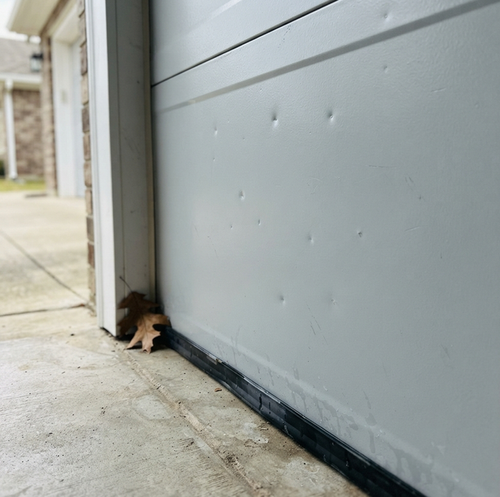
Quick Answer: Most hail marks on a garage door are cosmetic dimpling that won't affect how the door runs. But cracked panels, bent tracks, misaligned rollers, or hidden separation inside an insulated door's foam core can mean a repair isn't enough. The only way to know for sure is a close look at both the surface and how the door actually operates.
The storm passed hours ago, but you're still out in the driveway running a hand across your garage door, trying to decide how worried to be about what you're looking at. Some of what hail leaves behind is nothing more than a cosmetic mark you'll forget about by next season. Some of it is the first sign of a problem that gets worse every time the door cycles. Telling the two apart takes more than a glance from the street.
What Hail Actually Does to a Garage Door's Surface
Hail hits your garage door the same way it hits a car hood or a piece of siding: with a burst of concentrated force in a very small area. What that impact leaves behind depends on the size and speed of the hailstone, the angle it struck at, and the material of the door skin itself.
The mildest outcome is dimpling: small, shallow, rounded indentations spread across a panel where hailstones struck the metal skin without breaking it or pushing it far enough to affect the frame underneath. Dimpling is almost always cosmetic. It changes how the door looks in raking light, especially on a sunny afternoon, but it doesn't usually change how the door moves.
Denting is a step up in severity. A dent tends to be larger, deeper, or more irregular than a dimple, and it can start to affect the panel's flatness in a way that's visible even in flat light. Some dents stay purely cosmetic. Others begin to distort the panel edge where it meets the next section, which can interfere with how the sections seat against each other as the door travels.
Beyond dimpling and denting, hail can also cause actual structural damage: a bent or bowed panel, a cracked seam, a warped edge that no longer sits flush, or damage to the hardware and track assembly if hail combined with wind-driven debris or a falling branch during the same storm. This is the category that matters most because structural damage affects the door's ability to open, close, and seal properly, not just its appearance.
How Steel, Aluminum, and Insulated Doors Respond Differently
Not every garage door reacts to hail the same way, and knowing your door's construction is a useful starting point before you even walk outside to look.
Steel doors: Steel is relatively stiff, which means it resists denting up to a point, but once a hailstone is large or fast enough to leave a mark, that mark tends to be a true dent rather than a shallow dimple. Steel also holds its shape well once dented, so a shallow dent in a solid steel panel is generally a reliable picture of what happened rather than something that keeps spreading on its own.
Aluminum doors: Aluminum is softer and lighter than steel, so it dents more easily from the same size of hailstone. The upside is that aluminum panels are often easier to work back into shape for minor cosmetic dents, though deeper impacts can crease the metal in a way that's difficult to fully correct.
Insulated doors: Doors built with a layer of rigid foam sandwiched between two skins of steel or aluminum behave differently again. The outer skin can dent from an impact that barely reaches the inner skin, because the foam layer absorbs some of the force. That sounds like an advantage, and often it is, but it introduces a separate risk that solid single-skin doors don't have: the bond between the metal skin and the foam core can fail even when the outer dent looks minor.
The Hidden Delamination Risk in Insulated Doors
This is the part of hail damage that catches a lot of homeowners off guard. On an insulated door, the foam core is glued to the steel or aluminum skins to give the whole panel its rigidity and its energy performance. A hard enough impact can pop that bond loose in a localized spot without ever cracking the outer skin or leaving a dent large enough to notice from the driveway.
That separation is called delamination, and it's a problem specifically because it isn't always visible. A panel can look almost untouched from six feet away while the bond underneath has already failed at the impact point. Over time, that loose spot can flex differently than the rest of the panel, sometimes creating a soft or slightly springy feel when you press on it, or a faint drumming sound where the metal is no longer backed by solid foam.
Delamination matters for two reasons. First, it weakens the panel's rigidity right where it happened, which can make that section more prone to further denting or warping in the next storm. Second, that bond is part of what gives the panel its rigidity, so once it separates, the affected section can flex more than the rest of the door even though nothing about it looks different from outside. A panel can pass a casual glance and still have this kind of hidden damage, which is one reason a surface-level look isn't always enough after a serious hailstorm.
Cosmetic or Structural? How to Tell the Difference Yourself
You don't need special tools to get a rough read on severity, and doing a quick check yourself can help you decide how urgently to get a professional opinion. This isn't a substitute for a full inspection, but it's a reasonable first pass.
Cosmetic signs: Shallow, evenly spaced dimples that don't change the panel's overall flatness. The door still opens and closes at its normal speed, sits flush in the frame when closed, and doesn't make any new noises during operation. Weatherstripping along the bottom and sides still seals against the floor and jambs the way it did before the storm.
Structural signs: A section that looks bowed or wavy rather than just dimpled. Panel edges that no longer line up cleanly with the section above or below. New grinding, popping, or scraping sounds during operation. The door hesitating, reversing unexpectedly, or struggling partway through its travel. Gaps at the bottom seal or along the sides that weren't there before the storm. Any of these point toward damage that has moved past the surface and into the panel's structure, track alignment, or hardware.
One useful functional check is simply watching the door move through a full open-and-close cycle in daylight, paying attention to whether it travels smoothly at a consistent speed the whole way, rather than only glancing at the panels from the driveway. A door that looks fine standing still but hitches or shudders partway through its cycle is telling you something a visual scan alone would miss.
Can a Single Panel Be Replaced, or Do You Need a Whole New Door?
A sectional garage door is built, as the name suggests, from individual horizontal sections joined by hinges and rollers, and in many cases a single damaged section can be swapped out without replacing the whole door. This is often the more efficient path when the damage is limited to one or two panels and the rest of the door is sound.
Panel swaps have a practical limit, though: matching availability. Garage doors go through model changes, color runs, and texture updates over the years, and manufacturers don't keep every panel style in production indefinitely. If your door is a common, current model, a matching replacement section is usually easy to source. If it's older, discontinued, or a less common finish, a perfectly matched panel may no longer exist, and a close-but-not-identical replacement can leave a visible color or texture mismatch across the face of the door.
Whole-door replacement tends to make more sense when hail has affected multiple sections, when the track or opener hardware has also been compromised, when delamination is suspected across more than one panel, or when the door was already older, and a single new section wouldn't match well enough to look intentional.
What a Professional Hail-Damage Inspection Actually Covers
A proper hail-damage assessment goes beyond counting dimples on the outside of the door. A technician conducting a post-storm inspection typically checks several layers at once.
On the surface, that means checking the size, depth, and spread of dimpling and denting across every panel, not just the ones facing the street, since wind-driven hail can hit doors at an angle and concentrate damage unevenly. On the structure, it means checking each panel for flatness and looking for subtle bowing or warping that's easier to feel with a hand run across the surface than to see by eye.
The inspection also covers the door's moving parts: tracks checked for bends or misalignment, rollers and hinges checked for damage or binding, and the opener system tested to confirm the door travels smoothly through a full cycle without hesitation. For insulated doors, a technician will often press gently on suspect panels and listen for the give or hollow feel that can signal delamination, since that kind of damage doesn't always show up as a visible mark.
Finally, a thorough assessment looks at the door as a system rather than a collection of parts. A dented panel next to a slightly bent track can behave very differently than the same dent on a door with perfectly straight hardware, so the interaction between cosmetic damage and mechanical alignment is usually as important to the final call as the dents themselves.
Frequently Asked Questions
Yes, and this gets overlooked because everyone's eyes go straight to the metal. Hail-driven wind can tear or pull loose the top and side weatherstripping, and heavy hail bouncing off the slab in front of the door can nick or crack the bottom seal over a season of storms. Neither shows up when you're checking panels for dimples, but both let water and drafts into the garage just the same.
Darker finishes and smooth, non-textured surfaces tend to show dimpling more clearly because raking light casts sharper shadows across shallow indentations, while lighter colors and wood-grain or textured finishes can mask the same amount of physical damage.
It shouldn't, but it's worth asking about directly rather than assuming. Storm damage is generally treated as a separate event from a manufacturing defect, so a hail-damaged panel typically doesn't affect warranty coverage on the opener, springs, or other hardware that wasn't involved in the impact. Getting that in writing from whoever handles the repair avoids any confusion later if something unrelated needs service.
It's possible. A hard impact transmitted through the door to the track can jostle the opener's travel-limit or force settings slightly out of calibration, which sometimes shows up as the door reversing early or stopping short rather than as any visible panel damage.
It can, since wind-driven hail rarely falls straight down. A door facing into the prevailing direction a storm moved through often shows heavier, more concentrated damage low on the panels, while a door facing away or shielded by an overhang, a neighboring structure, or mature trees can come through the same storm with comparatively light marks. Two identical doors on the same street can end up in very different condition after one storm purely based on which way they face.
Yes, and the timing matters more than people expect. Fresh hail marks are easiest to see in the low, angled light of early morning or late afternoon, and a photo taken the same day captures the damage before rain, sun, or normal use starts to soften how visible it is. Photographing the whole door, not just the spots that stand out at a glance, gives you and a technician a clearer before-and-after reference if the damage turns out to be more than cosmetic.
Schedule a hail-damage inspection — get a clear read on whether your door needs a panel swap or a full replacement before small damage turns into a bigger repair. Arnold's Garage Door & Gates serves Fort Worth, Alvarado, and the DFW metroplex. Call Arnold: 682-337-7220.
