
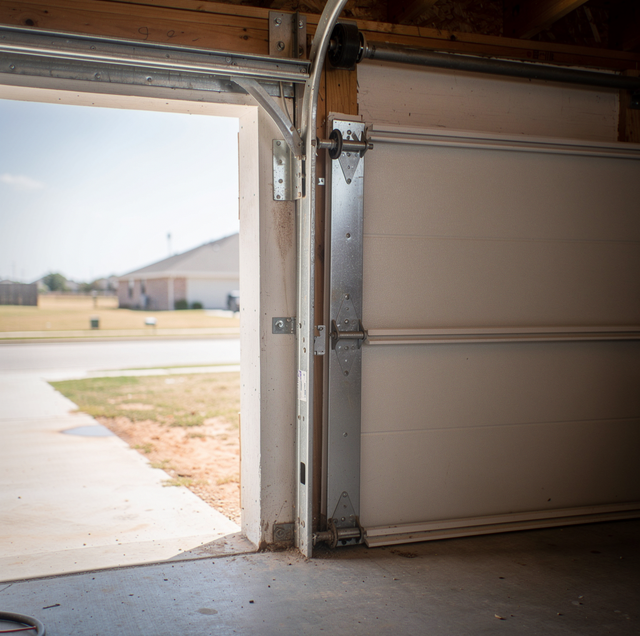
The door starts up smoothly, clears the first foot or two, and then hesitates at the same spot it always does. Sometimes it shudders through that point and keeps going. Sometimes it stalls there and the opener strains until it gives up and reverses. Either way, the door has found a reliable, repeatable place along its own travel where something resists it, and it finds that exact place again on the very next cycle.
That repeatability is the clue worth paying attention to. A random catch would appear at a different height each time. A door that stops at the same point, cycle after cycle, is running into a feature fixed at that height in the door's path.
Binding, Off Track and Out of Balance Feel Different
A door that is off track has lost the thing holding it captured to the wall; a roller has left the channel and the section is riding loose. A door whose balance has slipped has lost the counterweight matching its own hanging weight, and that shows up as trouble across the whole travel, heaviest right at the bottom of the run, where the spring is carrying the biggest share of the load. Binding is neither of those. The rollers are still within their channels, and the counterbalance is still roughly doing its job. What's changed is that one narrow band of the travel now requires the rollers to push against something they didn't have to push against before.
That distinction matters for what a technician looks at first. Off track sends someone to the cables and springs that stopped holding the corners even. A balance complaint sends them to the spring and its wind. A bind that shows up at one repeatable height sends them looking first for a physical feature at that height, though a spring whose torque does not track the door's weight through the travel can also hesitate at one point.
A Bracket Span That Sits Too Close to the Door
Every vertical track is bolted to the framing through a series of jamb brackets, usually spaced a couple of feet apart, and between brackets nothing else holds the track's spacing to the door edge. If one bracket shifts, even slightly, the track at that span ends up closer to the door's edge than it is to the door above and below it. The rollers riding through that span are pushed deeper into their hinges, and the section edge can drag against the jamb or the weatherstrip right there, at that height and nowhere else, because everywhere else the bracket spacing is still what it was set to.
The same signature appears wherever two straight sections of track bolt together using a splice plate. If the two tracks end at a splice that doesn't line up exactly, a roller meets a small step at that exact joint every time it passes through, and nowhere else, since the rest of the track has no joint to catch on. Neither a shifted bracket nor a misaligned splice moves between cycles, which is why the door produces the same symptom at the same height, run after run.
A framed opening that has drifted out of square can pinch the track at one span in exactly the same way, with no bracket or splice plate having loosened at all.
Where a bracket has shifted or a section has bent, the fix is to reset or replace that span, rather than forcing rollers through it.
The Horizontal Track's Angle Has Shifted
Overhead, the horizontal tracks are meant to run level or rising slightly toward the back wall, held up by hanger straps bolted into the ceiling joists or framing. Those straps carry real weight only while the door is open, since that's when the sections are riding in the horizontal track. A hanger that's loosened, or one anchored to a joist that's since settled, lets that end of the track sag a fraction lower than the other.
A sagging horizontal track changes the angle the curved transition, the radius, presents to an incoming roller. Instead of a smooth transition from vertical to horizontal, each roller encounters a slight kink where the radius intersects the vertical run, just above the vertical run. Every roller pair has to pass through that curve: the top pair almost as soon as the door starts up and each lower pair later, so a kinked transition produces a catch that repeats through the travel starting in the first few inches, while a tight span or a joint lower on the vertical track stays quiet until the first roller pair from below reaches it. A stall that lands right around the halfway point usually means one of the middle roller pairs is the one meeting it.
A door that binds partway up is usually still carrying its full spring load, even with nothing off track. Leave locating the pinch point to a garage door technician instead of reaching between the moving section and the track.
A Bent Hinge Angles the Roller Stem Into the Track
Each roller's stem sits in a hinge bolted to the door section, and that hinge is what sets the angle the stem, and with it the roller, presents to the track. A hinge that's been bent, even slightly, by a section flexing or a stray impact tilts the roller stem a few degrees off the angle the track expects. Most of the travel, that small tilt goes unnoticed. At the specific point where the panel carrying that hinge crosses a joint, a curve, or a spot where the track is already running a little tight, the tilted stem is what finally makes contact and drags.
This is why two doors can show an identical symptom, at an identical height, for two different reasons: one door's track has a tight span at that height, and the other door's track is fine, but a hinge on the panel passing through that height is angled wrong. Only a careful look at the track and the hardware riding through it, side by side, tells them apart.
When the Ground Moves the Opening Itself
Soil that's expansive clay swells when it soaks up moisture and shrinks again as it dries, and a slab sitting on ground that keeps doing that creeps a bit at a time across years rather than moving all at once. The framed opening the tracks bolt to rides on that same slab, so as it works its way out of square, the jambs the tracks hang from lean or bow by different amounts, and the door meets the tightest point wherever the framing has shifted most. A door that stalls at the same spot every cycle may be following a slow drift rather than anything being wrong with its hardware at all.
The tell is in how the stall behaves over time rather than in any one visit. A bind that shifts height, or gets a little worse through a wet stretch and eases back in a dry one, is following the building; a bind that sits at the identical spot regardless of the season points first at the hardware, a jamb bracket, a splice, a bent hinge, or a spring whose torque has stopped tracking the door's weight through its travel. Re-setting the tracks to an opening that is still moving holds only until the opening moves again.
A door hung in an opening that keeps moving can only be re-set to the shape that opening holds today; the building's own movement is a matter for its foundation, not for the door hardware riding on it.
Frequently Asked Questions
Yes. The stop molding that seals the door's sides is nailed to the jamb, and where a length of it was set too tight or has swollen, the door's edge rubs against it at that one height every cycle. The tell is a scuffed or shiny strip on the seal itself, right where the door catches.
Yes. A new section whose hinge and roller-bracket holes don't sit in exactly the same spots as the original's presents its rollers at a slightly different depth, so the catch begins at the height where that panel meets a joint or the radius, a bind that wasn't there with the panel it replaced.
It can. On standard-lift track, the radius sits close to the top of the opening, while high-lift track carries the vertical run farther up the wall before the curve begins, so the top roller pair travels farther before it meets a kinked transition. Vertical-lift track has no curve at all, since the door travels straight up and the track never turns horizontal, so a same-height bind on that configuration points back to the vertical track itself rather than to the radius.
No. Shorter tracks can be cut and shipped as a single continuous piece on each side, with no joint at all, whereas taller sectional doors often require a splice to reach full length. A door with no splice plate that still binds at one height is pointing at a bracket or the radius instead of a joint that isn't there.
Because the two vertical tracks are independent pieces of hardware bolted to independent points on the framing. A bracket loosening on the left side of the opening has no reason to affect the right side's track at all, so a one-sided bind usually means the cause is isolated to that side's brackets, splice, or the hinges on the panels riding through it, unless the opening itself has shifted, in which case both sides can end up affected, just not by the same amount.
Yes, and the two spots don't have to line up. A bottom section flexed by a bumper strike or a hard auto-reverse can angle its hinges and roller stems just enough to drag, but the drag itself only shows up once that section's rollers reach a joint or the radius farther up the travel, so the visible dent and the height where the door catches don't have to match.
Ask for a garage door repair visit — a technician traces exactly where your door catches, from the brackets and splice joints to the radius and each hinge. Arnold's Garage Door & Gates serves Fort Worth, Alvarado, and the DFW metroplex. Call Arnold: 682-337-7220.