
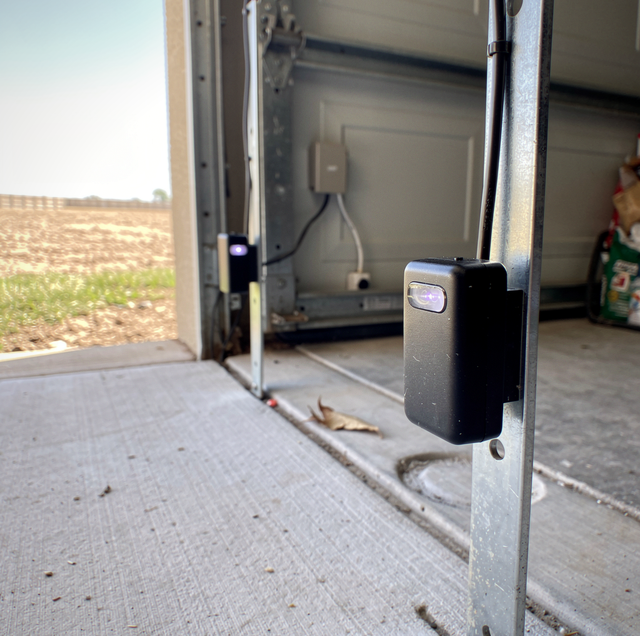
Down by the track, a few inches off the concrete, one of the two small black boxes has a light that will not stop blinking. The other one is glowing steady. That difference between the two is the most specific piece of diagnostic information the opener will hand you without tools, and it is the thing most people walk past on their way to inspecting a bracket.
Why a door reverses in general, and the full walk-through of everything that can cause it, is a broader question this article does not take up. What follows is narrower: how to read the pair of lights, what each state actually rules in or out, and where the reading stops.
Which Unit Is Sending and Which Is Receiving
The pair mounted low on the two tracks is not two of the same thing. One unit emits a continuous infrared beam across the opening. The other has a photodiode behind its lens and does nothing but watch for that beam, then report to the opener whether it is present. The emitter has one job and essentially one failure state. The receiver has several, because it is the half that has to interpret something.
That asymmetry is what makes the lights readable. The emitter's light is close to a bare power indicator: it says the unit is energized, and nothing more, because an emitter has no way of knowing whether anything received what it sent. The receiver's light is the informative one, since it changes state based on what actually arrives through the opening.
Which of your two is which is printed on the housing on most residential units, and manufacturers commonly assign different indicator colors to the two roles. Which color means which is model-specific, so the housing label or that model's manual is the only reliable source. Identifying the receiver takes about thirty seconds, and everything below depends on it.
Steady, Blinking, Dark: Three Different States
These are three categories, not three degrees of the same thing.
Steady on both units is the normal running condition. Both are powered, and the receiver is seeing a clean, uninterrupted beam.
Blinking on the receiver means it is powered but not getting what it expects. The beam is broken, weakened, or arriving off-axis. This is the state that keeps a door from closing.
Dark is a different category entirely. A unit showing no light at all is not reporting a beam problem; it is reporting that it has no power, which points at the wire, the terminal, or the opener rather than at anything in the doorway. A dark emitter also makes the receiver blink, and that combination is the one most often misread.
| What You're Seeing | What It Points To First |
|---|---|
| Both lights steady | Both units powered and the beam intact; see the FAQ below for the one case that survives this |
| Receiver blinking, emitter steady | Something interrupting or weakening the beam, or a receiver aimed off-axis |
| Receiver blinking, emitter dark | A power or wiring fault on the emitter side, not an obstruction |
| Both units dark | Power lost to the pair, at the terminal or the opener |
Why the Blinking Unit Is Often Not the Faulty One
A blinking receiver reports a symptom, not a location. It says the beam is not arriving properly. It cannot say why, and it cannot say from which end. The emitter could be dead, misaimed, or unpowered. The beam path could be interrupted at any point along its length. The receiver's own lens or aim could be the trouble. All of that produces the same blink.
That is the single most useful thing to understand about the pair, because the instinct is to work on the flashing unit. When the emitter is dark, and the receiver is blinking, the flashing unit is the healthy one, and every minute spent adjusting its bracket is wasted. Read both lights together before choosing a side, and read them under the conditions in which the fault actually occurs, since a fault that only appears mid-cycle will not show itself while the door sits parked open.
Note which unit blinks and which is steady before touching anything. Correcting an alignment resets the evidence, and the original pattern is what tells a technician which side of the opening to start on.
What the Light Is Pointing You At
Once the two lights have narrowed down which side to approach, four ordinary causes account for most of what a blinking receiver complains about. What matters below is not the repair walk-through; it is what the light confirms in each case and what it leaves open.
An object in the beam path produces a blink that stops the instant the object is removed, and stays stopped. If the light goes steady and holds while you stand clear, obstruction is confirmed, and nothing further about the sensors needs checking. If it goes steady while something is moved and then blinks again on its own, that object was never the cause.
Bracket alignment produces a blink that responds gradually to small movements rather than switching cleanly. A light that creeps toward steady, as a bracket is nudged and falls back when released, tells you the aim is marginal, and the bracket is not holding, which is a different repair from an aim that is simply off.
A filmed or fogged lens is the case where the light reports worst, because a partly obscured beam can still read as present while everything is still and fail once the door's travel changes the geometry slightly. A receiver that holds steady with the door parked and blinks only during travel is pointing at a weak beam rather than an absent one.
A wiring fault usually shows up in the dark state rather than the blinking one, or in a light that changes when the wire is disturbed. A light that flickers when a run of wire is touched has located the fault in that run, which is more than a blink alone can do. That is also where the reading stops for a homeowner.
Never disconnect, tape over, or wire around a safety sensor to force the door to close past a fault. That defeats auto-reverse, the function that stops the door on an obstruction, and it is the single most dangerous shortcut in this list.
What the Light Cannot Tell You
A steady pair confirms two things and no more: both units have power, and infrared is crossing the opening. It does not confirm that the receiver's output is reaching the opener's logic board correctly, that the opener is acting on it, or that the beam crosses at the height and angle needed to catch a low object rather than merely finding its partner's lens.
It also says nothing about the rest of the door. An opener will reverse a closing door for reasons unrelated to the beam: resistance in the travel that reads as an obstruction, or a travel limit that expects the floor sooner or later than the door reaches it. Both leave the sensor lights steady the whole time. A door that reverses with two steady lights has effectively cleared the pair and pointed somewhere else.
And there is no universal decode for how many times a light flashes. The powerhead carries its own diagnostic light, separate from the two sensors', and manufacturers do assign meaning to flash counts. That meaning is not consistent across brands or even across a single brand's product line, so the label on the powerhead or that model's manual is the only place the mapping exists, and no chart printed anywhere is worth memorizing.
What a Technician Reads That You Can't
The reading a homeowner can do ends at the two lights and the beam path. What a technician adds is measurement rather than inference.
That means putting a meter on the sensor terminals to see actual supply voltage rather than assuming a screw is tight, checking continuity along the full length of each sensor run to find a break that shows nothing at either end, and reading the powerhead's diagnostic light against that model's published fault codes. It also means checking the pair's mounting height and the beam's path against how the door actually travels, and testing auto-reverse and the manual release together rather than treating a steady light as proof the safety system works.
Safety sensors have been standard equipment on residential openers for decades because a door that closes on something without stopping is a real hazard rather than a hypothetical one. A light still blinking after the readable checks means the system says the rest of the diagnosis requires tools.
Frequently Asked Questions
A hand at the lens blocks the beam right at the source, but real faults often break the connection farther along the path, near the opposite unit, where a slight misalignment has more room to miss. Blocking each lens separately, one at a time, is closer to what the pair actually experiences.
Two distinct mechanisms can produce a clockwork fault, and one test can distinguish between them. Thermal movement is the first: the track and the brackets are steel, and a bracket already marginal on aim can walk out of alignment as the metal expands through the warm part of the day, then return on its own as it cools. Direct light is the second, since a receiver reads infrared and strong low-angle light arriving into the lens raises the background enough that the beam no longer stands out from it. A light-driven fault disappears entirely under heavy cloud. A thermal one still happens on an overcast day.
It can. Thicker weatherstripping or trim added along the bottom of the door or the jamb can sit close enough to the beam's path to trip a fault only at the very end of the close cycle, which reads as a door that almost seats and then changes its mind.
For practical purposes, yes, with one exception worth knowing. The light tells you the receiver sees the beam. It does not indicate that the receiver's output circuit is passing that signal to the opener. A receiver whose internal switching has failed in the blocked position holds the opener in a fault state while its own light glows perfectly steady. The tell is that the door refuses to start closing at all, rather than starting down and reversing, because the opener never accepts the close command in the first place.
Sometimes, temporarily. A power cycle can clear a logic-board fault caused by a brief voltage dip. If the fault returns within a day or two, that points at a hardware problem rather than something that only needed clearing.
Yes, and those are among the harder ones to catch. A dog crossing the beam at dusk, or a sprinkler head rising to beam height mid-cycle, can each trip a fault that is long gone by the time anyone goes to look. A fault that repeats on the same schedule as a timer, rather than at random, is worth checking against whatever else in the yard runs on that timer.
Bring in a trained eye for the sensor fault — a full check of the pair, the wiring, and the opener itself, done right the first time. Arnold's Garage Door & Gates serves Fort Worth, Alvarado, and the DFW metroplex. Call Arnold: 682-337-7220.