
Should You Replace Both Garage Door Openers or Just One?
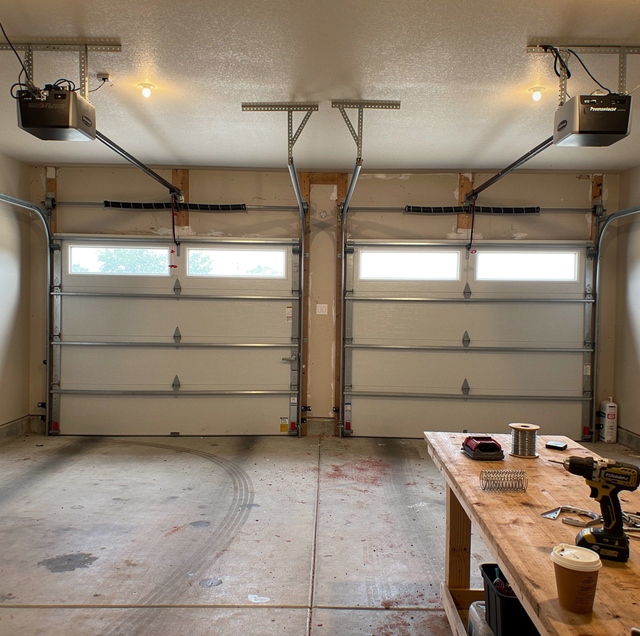
One opener quit. The other still lifts its door on every press, and that gap is the whole decision. A single-door house never faces it, because there is nothing to weigh the failed unit against.
Two bays put a dead motor and a working one on the same wall, and that arrangement adds a second question behind the first. You can deal with what broke and leave the other alone, or you can treat this as the moment both units come up to the same standard. Both answers are defensible on the right day, and which one fits your garage turns on specific facts about it rather than on the fact that there happen to be two openers up there.
Whether the failed unit is a repair or a replacement in the first place is a separate question, and this piece sets it aside. What follows is the case for doing both set against the case for doing just the one, laid out the way an installer would work through it standing under your ceiling.
One Control System Across Both Doors Is the Strongest Case for Doing Both
The strongest argument for replacing both openers together has nothing to do with either motor's condition. It sits in what happens in your hand and on your wall afterward. Two openers from the same generation, ideally the same product line, can share one handheld remote and one keypad instead of two: press a button, either door answers, and one visor remote goes in each vehicle instead of a drawer of clickers that each work on only one bay.
That matters every time someone new needs access, whether the person is a house sitter, a contractor, or a teenager who just started driving. One control ecosystem means one thing to teach and one code to issue. Two separate systems, even when both work perfectly on their own, mean remembering which remote opens which door, and that small daily friction does not resolve itself.
A Working Second Opener Earns the Benefit of the Doubt
Set against that convenience is a plain fact: an opener that raises and lowers its door on command, holds position without drifting, and stops and reverses when something is in the way is a working machine. A repair-first shop replaces a unit when it has failed, or when a technician has identified a specific fault that repair will not resolve. Standing next to a newer neighbor is not one of those triggers, and retiring a functioning motor to make a matched pair spends equipment that still has service left in it.
Two openers under one roof also rarely split the traffic evenly, so the bay nearest the house door tends to handle the daily runs while the other opens far less often, and the two motors end up at different points in their working lives despite a shared install date. Where each unit sits on that count is a lifespan matter with its own arithmetic and its own coverage, and the question in front of you today is narrower than that.
The narrower version is an inspection question. Because a technician is already in the garage with the ladder up and both doors available, the survivor can be run, listened to, and looked over on the same visit as the failure beside it: how it starts, whether the drive has developed play, whether the trolley runs the rail clean end to end, whether the safety reversal still behaves the way it should. What that produces is either a named condition on a specific part or a clean bill on the machine as it stands, and either one beats a guess worked backward from the year the house was built. Ask for the survivor's condition in those terms, and a shop that sells honestly will answer accordingly.
The Visit Changes Shape When Two Units Are on the Ceiling
Almost everything about a service call gets set up once and torn down once. The ladder comes out, the ceiling outlets get checked, the rails and mounting points get eyes on them, and the old hardware leaves in one load. When two units are involved, that covers both bays for the same disruption to your afternoon, and the second door does not need its own appointment, its own arrival window, or its own morning spent moving the contents of the garage out of the way.
Sequencing matters as much as logistics. A technician replacing one opener has the other bay open and powered during the same visit, which is the easiest moment there will ever be to catch a fault on the survivor. If both units are going up, they use the same generation of hardware, which leaves one set of accessories, one set of manuals, and one answer years from now when a keypad or wall console needs replacing, instead of two answers you have to keep straight.
A New Opener Beside an Old One Leaves the Old Controls Alone
Replacing one unit does not disturb the other one's controls. The keypad by the side door and the remotes already riding in the vehicles go on doing exactly what they did for the door that was not touched. Nothing on that bay gets recoded or knocked out of alignment because a new motor was installed overhead.
What a mixed-generation pair does change is which accessory reaches which door. A remote or keypad built for the new unit's product line may or may not communicate with an opener several generations older, and the reverse holds true as well, so the wireless keypad mounted outside the old bay is not automatically the keypad for the new one. Compatibility is determined by the model and brand, not by any general rule, which is why it is confirmed for the specific pair on your ceiling rather than assumed. The practical result is that you carry two control paths for as long as the old unit stays, and keeping track of which device covers which door is the entire inconvenience.
Replacing only one opener does change how the two doors sound side by side. A new belt-drive unit runs quieter than an aging chain drive, even when both are installed and adjusted correctly, and that contrast can read as a fault.
A Second Door Changes What a Failure Costs You
A one-door house loses its garage completely when the opener quits. A two-door house does not, and that difference shapes the decision more than it should. The working bay absorbs the traffic, the dead door gets left disconnected from its opener or simply left closed, and the urgency drains out of the problem inside a day.
That cushion is real, and it is also where two-door houses get caught. A fault on the quiet bay can go unnoticed for weeks because nobody is there when it happens, and a door that stops short of full close at a bay nobody visits becomes an exposure the household learns about late. Two units also mean two of everything that can fail: two motors, two logic boards, two pairs of safety sensors, and two sets of springs and rollers carrying the load the opener does not. A second door does not remove the risk of being caught out by a failure; it just makes the first one painless, and that is the argument for having the survivor assessed while someone is already standing in the garage.
Matched Control Doesn't Always Require Matched Hardware
None of the convenience argument requires two new motors. A universal remote or keypad can bridge two brands or two generations of one brand onto a shared control without affecting the opener that still works. It will not cover every model on the market, and it means programming one more device instead of relying on what came in the box, but it closes a real gap in the claim that matching remotes require matching hardware. If the appeal of doing both is mostly about not juggling two clickers, that appeal can often be answered while the working motor stays where it is.
The factors that settle it, and the direction each one points:
| Factor | Points Toward Replacing Only the Failed Opener | Points Toward Replacing Both |
|---|---|---|
| The survivor's inspected condition | Runs its door end to end, no play in the drive, nothing named by the technician | A specific fault found on the day, with age playing no part in the finding |
| Which bay carries the daily traffic | The working unit serves a bay that opens a few times a month | Both doors run the same schedule for the same vehicles |
| Accessory generation | The existing keypad and remotes still cover the door they were paired to | Any new accessory would have to reach two receivers that do not share a product line |
Two Doors on One Wall Change the Math
The comparison is what makes this hard. A working motor and a dead one on the same wall make fixing only the broken one feel incomplete, even when it is the right call, and make replacing both while someone is already on site tempting, even when the second unit has not earned it. The way through is to treat the two openers as two cases that happen to share a ceiling. Judge the failed one by what a technician finds wrong with it; judge the survivor by its own inspected condition and its own bay's traffic; and let the shared-remote convenience stand or fall on its own merits instead of letting it decide everything by default. A decision reached that way holds up whichever direction it lands.
Frequently Asked Questions
Not on rolling-code units. Each remote and receiver pairing generates a fresh code on every press, so one opener's signal means nothing to the unit hanging beside it. The exception is older fixed-code equipment, where a remote is set with a small bank of DIP switches and any receiver carrying the same switch pattern answers it. Two builder-installed openers of the same vintage are the most likely to share a pattern, and switching to rolling-code units ends the problem.
No. Pairings live in each opener's own receiver memory, so the unit nobody touched keeps every remote and keypad already taught to it. The new opener arrives with an empty memory from the factory and has its remotes and keypad paired with it during the install, which is the only programming the job involves.
No. Each door's photo-eye pair wires back to its own opener's logic board and is aligned to its own bracket height, so work on one bay's motor has no bearing on the other bay's sensors. If the untouched door starts reversing after the visit, the cause lies with that door's sensors or hardware rather than with the new unit overhead.
Usually not. In-car systems like HomeLink typically store several codes independently, so a vehicle already programmed to one door generally accepts a second, differently branded opener without conflict. A handheld remote does not have that flexibility unless it is swapped for a universal model.
Not automatically. Battery backup is offered on DC-motor models, but whether a specific unit includes it depends on the model tier rather than on the motor type alone. Two openers bought on the same visit can still end up with different backup coverage if different tiers are chosen for each door.
No. Horsepower class is chosen by each door's weight and width, not by matching the neighboring unit. A heavier door can justify a stronger motor, while the lighter door beside it runs fine on a smaller class; that difference has no bearing on whether the two share a remote system.
Does the opener that still runs need anything, or only the one that quit — an on-site look at both doors gives you that answer before you commit to either path. Arnold's Garage Door & Gates serves Fort Worth, Alvarado, and the DFW metroplex. Call Arnold: 682-337-7220.
