
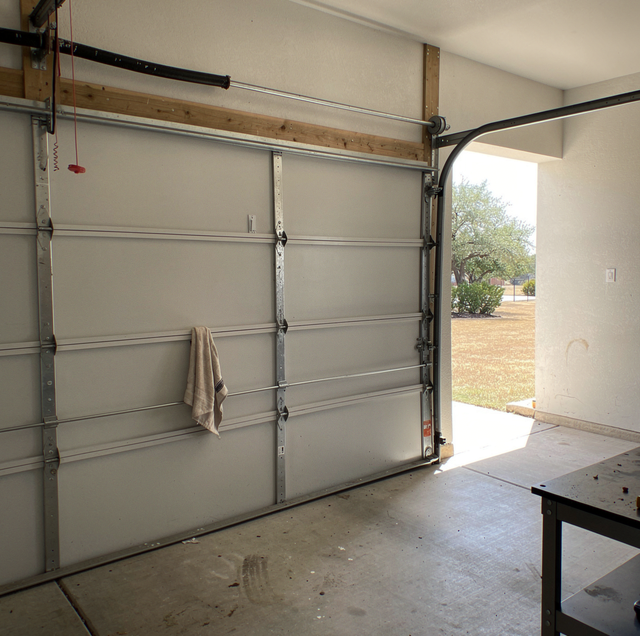
Headroom is the space between the top of a garage door's opening and whatever sits closest above it, whether that is a bare ceiling, a beam, a duct run, or a sloped section of roof. A standard track and the torsion spring that rides above the header both need a set amount of that space to curve the door from vertical to horizontal and to hold the shaft, drums, and spring bracket. When that space is missing, the answer is a track-and-spring layout built for the room above the opening.
Several layouts solve the same problem in different ways, and each one trades something for the space it saves. Setting the main options side by side shows what each one asks for and what changes once the door is in:
| Track and Spring Option | Where the Space Comes From | How the Door Rides Into the Opening | What It Asks of the Opener | What Changes for Upkeep |
|---|---|---|---|---|
| Standard-radius track, spring mounted at the header | Needs room above the opening for the full radius and the spring | Curves from vertical to horizontal in one tight radius, right at the top | Works with any standard rail-and-trolley or wall-mount unit | Spring and shaft sit in the open above the door, clear for a technician to reach |
| Low-headroom double track | Spreads the curve across two parallel tracks instead of one tight radius | The top section tips back from the start of travel on its own upper track; the rest follow the lower curve | A rail-and-trolley unit needs travel room above the door's highest point, and a wall-mounted unit on the shaft is the answer where that room is gone | The top section's upper rollers wear on a separate track from the rest, so service covers both tracks |
| Rear-mounted torsion spring | Moves the shaft off the header and back along the horizontal track | Curve stays standard; only the spring's position changes | Opener fit depends on where the shaft ends up | Spring sits farther back in the garage, past whatever is stored along that stretch of track |
| Extension springs | Uses the side tracks instead of a shaft above the header at all | Standard curve, with lift coming from stretching springs along each side rather than a twisting shaft | Takes a rail-and-trolley unit; a wall-mounted unit needs a torsion shaft to turn, so it does not fit this layout | Two springs and a pulley-and-cable run to inspect instead of one shaft |
| High-lift or full vertical-lift track | Uses extra ceiling height rather than saving it, the opposite problem, for a tall ceiling over a shorter opening | Rises vertically past the opening's top before curving, or does not curve at all | Needs a rail extension kit or a wall-mounted unit sized for the longer or vertical run | Track, drums, and spring are a different parts list than a standard-lift door uses |
Measuring Headroom, Sideroom, and Backroom
Headroom is one of three measurements that decide what will fit, and it is never read on its own. Sideroom, the clear width beside the opening at each jamb, has to hold the vertical track and its end bearing plate, and backroom, how far the horizontal track can run into the garage, has to give the door somewhere to travel once it curves. A tight ceiling with generous sideroom and backroom still narrows the field to the layouts built for low headroom; a garage tight on all three narrows it further. Getting an opener onto an already-installed door is a separate measurement taken later, once the track and spring layout is settled.
How a Low-Headroom Double Track Changes the Curve
A standard track bends from vertical to horizontal in one radius section. A low-headroom kit runs two horizontal tracks side by side: the top section's upper rollers enter an upper track at the opening's top edge, while the rollers in the other sections follow the lower track's curve. The top section tips back the moment the door begins to rise, so the door's highest point of travel sits lower against the ceiling than a single-radius curve allows. The tradeoff is alignment: the upper and lower tracks have to line up with each other as well as with the opening, a check a single-track door never needs.
Moving the Torsion Spring to the Rear of the Track
A standard torsion spring sits centered on a shaft right above the door, in the same narrow band of ceiling the radius curve needs. Relocating the shaft to a bracket farther back on the horizontal track frees that space above the header without touching the curve at all, and the door still rises through the same standard radius it would with a front-mounted spring. What moves is only the shaft, the drums, and the spring itself, riding on brackets attached to the horizontal track rather than the header wall. The spring still winds and unwinds the same way and still needs the same clearance around it that any torsion spring does; it is simply positioned somewhere else in the garage where that clearance already exists.
Openers That Work in a Tight Garage
Each track and spring layout takes an opener of some kind; which kind depends on the springs and the space. A standard rail-and-trolley unit still needs a straight run of ceiling behind the door for the rail, and a low-headroom curve or a rear-mounted spring does not change that requirement. Where the ceiling is too tight or too obstructed for any rail to run, a wall-mounted unit that turns the shaft itself, rather than traveling along the ceiling, sidesteps the rail question for a door that runs on a torsion shaft.
What a Low-Headroom Layout Changes for Seals and Service
A tighter curve changes more than the ceiling clearance. The top section's weatherstrip meets the header at a different angle on a compressed curve, so its seal is set to that curve. A rear-mounted spring changes what a technician has to reach around rather than what seals: storage, shelving, or a workbench positioned along the back half of the track can now sit near the shaft, and keeping that stretch of track clear matters more than it does on a door whose spring lives above the header.
How the Track and Spring Choice Gets Made
The obstruction itself narrows the field first. A duct, a light fixture, or a storage rack fixed to the ceiling near the header can sometimes move to make room for a standard layout; a structural beam, a truss chord, or a sloped roofline cannot move at all, and the track has to work around it instead. Door weight further narrows it, since extension springs are only an option within the weight range they are built for, whereas a low-headroom double track or a rear-mounted torsion spring can carry a heavier door in the same way a standard layout would. Whether an opener is already installed, being added now, or planned for later factors in too, since a wall-mounted unit changes which wall space needs to stay clear. None of this is decided by the ceiling type alone; it is measured, obstruction by obstruction, before any hardware is ordered.
Garage door springs hold enough stored energy to injure or kill, and section joints and track can crush fingers while the door moves; a technician handles any spring, cable, or bracket move, and a structural professional decides any joist or truss change.
Frequently Asked Questions
It can. A wall-mounted opener drives the torsion shaft from one end, working from the wall beside the door, so that shaft end has to sit within reach there. Moving the shaft to the rear of the horizontal track takes its end away from that wall, so on a rear-spring layout the fit is confirmed for that door before the unit is chosen.
Not by material. What a panel choice changes is the door's weight: insulation, a heavier steel gauge, or glass sections all add to it, and the springs are sized to the finished door with all of that included, so the panels are settled before the spring is.
It can. The double track adds a second track and its brackets at the curve, where a single-track door has one, and on some layouts the torsion spring hardware sits in a different place along the header, so the sideroom beside the opening needs to hold that extra hardware as well.
It does at the top section. Its upper rollers ride in their own upper track, so that section has its own top brackets, set to carry those rollers into the upper track rather than the lower curve.
Not from its position alone. A torsion shaft carries the same torque and the same turn count no matter where along the track its bracket sits, so what wears a spring is the door's weight and how many cycles it runs, not whether the spring is positioned above the door or farther back.
Not automatically. A finished ceiling only rules out a standard layout once the drywall and any framing behind it are accounted for and the clear space left is measured; some finished garages still have enough room above the header. That is why headroom is measured on-site rather than assumed based on whether the ceiling is finished or open.
Secure a low-headroom garage door installation — a track and spring layout matched to the ceiling, side room, and back room of a tight garage. Arnold's Garage Door & Gates serves Fort Worth, Alvarado, and the DFW metroplex. Call Arnold: 682-337-7220.