
Garage Door Opener Horsepower: Weight Decides the Class
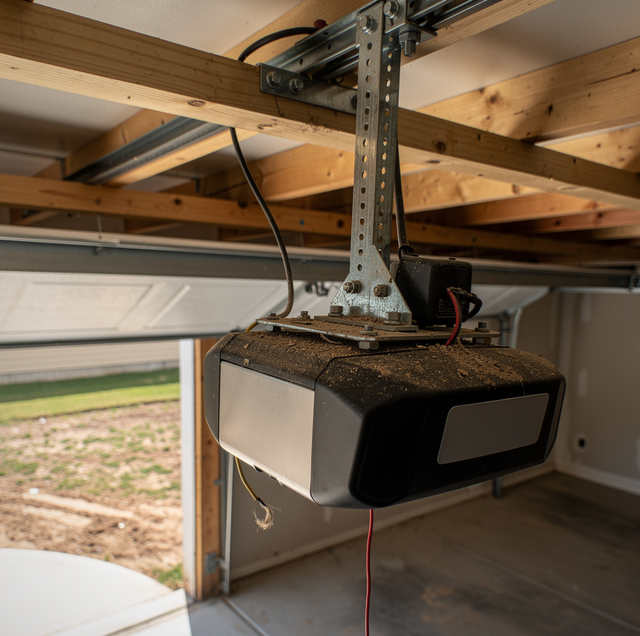
The number sits on a foil label near the light socket, or stamped into the end cap of the motor housing: 1/2 HP. You probably read it once from a ladder while changing that bulb, filed it away as the size of your opener, and never thought about it again. It does describe the machine. It describes very little about the door hanging underneath, and the door determines whether that machine has an easy life or a short one. Automating a manual door in the first place is a separate question from what class it needs once it is opener-ready.
Sizing an opener is a question about the door first, and weight is the input that determines more than any other, including the size of the opening itself. Construction, insulation, the condition of the parts that move it, and how hard the household works it all shift the number a class up or down, but two doors covering the same opening can differ by a wide margin depending on what the panels are made of.
Horsepower on an Opener Label Names a Family of Parts
The rating is a class designation. It groups a motor with the gear reduction, rail, trolley, and control board that a manufacturer sells together at that tier, so one product line can be sorted from light-duty to heavy-duty on a shelf. You cannot verify it with a meter on your garage ceiling, and two units from different makers wearing the same class label can pull a door with noticeably different character.
What does move with the class is the whole package around the motor. Step up from 1/2 HP to 3/4 HP to 1 HP, and the rail and trolley get heavier, the gear set gets more material, and the board permits more force before it decides the door has hit something. The label is a shorthand for that entire assembly rather than a measured output at the shaft.
Class and motor type are different lines on the same box: An AC unit and a DC unit are both sold at 3/4 HP, and the choice between those motor types turns on how the opener runs rather than on how much door it can move. Brand works the same way, since every major manufacturer offers all three classes.
Manufacturers also publish the door sizes and weights each unit is approved for, and that pairing tells you more than the class number standing alone.
Door Weight Drives the Class More Than Any Other Input
Two doors can cover the same opening and differ by a large margin in what they ask of a motor. A single-layer steel door is one skin of light-gauge steel with struts across the back. A three-layer door adds a core and a second steel skin. A wood or wood-overlay carriage door carries solid stiles and rails. Full-view aluminum doors with glass panels sit heavier than their thin frames suggest.
This is why width alone misleads people. A 16-foot single-layer uninsulated steel door is wide, but it is thin material spread over a big opening. A narrower insulated door, or a solid wood door at a modest width, can outweigh it while looking like the smaller job. If you size from the opening dimensions and ignore what the panels are made of, you can land a class low on the wide door and a class high on the small one.
Buying guides published by the large home centers do attach rough weight ceilings to each class, on the order of 350 pounds for a 1/2 HP unit and 600 pounds for a 3/4 HP unit. Those figures shift from one source to the next, which is the tell that they are orientation rather than specification.
Ask which class the door manufacturer specifies for your exact model and height. Door makers publish weights for their panel sections, and that published figure settles the class faster than any rule of thumb built on width alone.
A Wider Door Loads the Motor Differently Than a Taller One
Width and height are not interchangeable. Extra width adds panel area, adds hardware, and adds the twisting and flexing that come with a long horizontal span, which is why a double door is a bigger step up than the extra few feet suggest. Extra height adds travel distance. The motor is not working harder at any instant on a taller door; it is working for longer on every cycle.
Common residential doors run from 10x10 through 14x14, but two doors at the same size can sit a class apart once construction is factored in. Manufacturers publish their own weight and size approvals, so treat the table below as orientation for what tips the decision rather than a substitute for the model's own listing.
| Class | What pushes the choice up a class |
|---|---|
| 1/2 HP | Added insulation, a second steel skin |
| 3/4 HP | Solid wood construction, widths toward the top of the range |
| 1 HP | Heavy daily use, doors carrying overlay or full-view glass |
*Manufacturer approvals for your specific door are the reference point; the figures above are general orientation, not a substitute for that listing.*
Insulation Adds Real Weight to the Same Opening
Insulation appears on a spec sheet as an R-value and on the opener as pounds. A polystyrene panel slid into the back of a steel skin adds a little. A polyurethane core foamed in place between two steel skins adds more, and it bonds the skins together into a stiffer panel that resists flexing. That stiffness is a real benefit for the door and a real increase in load for the motor.
The comfort side is worth weighing against those pounds. An insulated door can drop the temperature inside a garage by up to 15 degrees, which matters in an unconditioned space where summer heat is severe, or where a room sits above the garage.
So a door swap from single-layer to insulated is a sizing event. If your existing opener was sized correctly for the door you took down, it may be undersized for the door going up, even though the opening never changed.
Hardware Condition Decides Whether the Class Question Even Applies
Rollers with worn bearings drag against the track. Bent track pinches at one point in travel. Loose or cracked hinges let a section twist as it goes through the curve. Any of these adds resistance unrelated to the door's weight, and the motor pays for it on every cycle. Choosing a class against a door in that condition means sizing to the friction rather than to the door.
Balance is the harder version of the same problem. A door's springs carry nearly all of its weight when they are properly adjusted, leaving the motor to manage only what remains. A door whose springs no longer hold it hands the motor a load that no horsepower class is rated to lift. Sizing up does not solve that, and there is nothing on any shelf that does.
A door that will not stay where you leave it is unsafe to operate and unsafe to stand under. Keep it closed, keep people and vehicles clear, and have the springs and cables looked at by a technician.
This is also where oversizing stops being harmless. Extra capability is extra force available to push into a door that binds, and a door that binds does not get better for being shoved through the tight spot. The resistance gets absorbed by rollers, hinges, brackets, and the top section where the arm attaches. A correctly sized opener on a door that moves freely is easier on the whole system than a bigger unit compensating for a mechanical problem.
How Hard You Work the Door Sets the Margin You Want
A door that opens twice a day is a different machine from one serving as the household's main entrance. What changes is how much recovery time the motor gets between cycles, and how many hours a year the gear set spends under load.
That is what buying margin means in practice. A unit running at the top of its capability every cycle wears differently from one running comfortably within its range, and the difference shows up in heat, gear reduction, and how the unit sounds after a few years. Back-to-back cycles are the hardest case, because the second one starts before the motor has shed the heat from the first.
Margin is also insurance against the door changing. Adding insulation, replacing a light door with a heavier one, or adding a decorative overlay all move the load upward without touching the opener.
What a Technician Weighs That the Spec Sheet Does Not Print
A spec sheet knows the class and the approved door sizes. It does not know how your particular door behaves in motion. Someone watching a full cycle sees where in travel the door gets heavy, whether it hesitates at the same point every time, and whether the sound changes near the top. Those details decide whether a class up is buying real margin or covering for something that should be repaired first.
Timing is the other input. If a door replacement is already in the plan, the sensible move is to size for the door that is coming rather than the one on its way out, and a sound door with years left in it does not need an opener sized for a hypothetical future one.
The condition of the parts left behind matters too. If the rollers, hinges, and bearings are all being replaced during the install, the door the new opener sees is a lighter-running door than the one that was there that morning. If none of that is being touched, the opener inherits every bit of drag the old one was fighting, and that belongs in the sizing conversation rather than being discovered later.
Frequently Asked Questions
Not usually. Jackshaft units mount on the wall beside the torsion bar and drive the shaft directly, and manufacturers commonly list them without a horsepower class at all. Instead, they publish the maximum door weight and height each model is approved for, which is the figure to compare against your door.
The class already installed is weak evidence at best. Openers that come with a house are frequently specified to a builder's minimum rather than to the door that ended up hanging there, so the original may have been a class light from its first day. Treat the replacement as a fresh sizing question against the door in front of you rather than copying the label off the old unit.
Battery backup does not change the class your door calls for, but it does change how the unit behaves during an outage. Manufacturers publish a limited number of cycles a unit will complete on backup power before the battery is spent, and a door working the motor near the top of its class will drain that reserve faster than a door with margin.
Height and class are separate problems. Openers ship with a rail sized for a standard-height door, and a taller door needs a rail extension kit to reach the top of travel regardless of how much motor is behind it. Check that an extension kit is available for the model you are considering before you settle on a class.
No. Two separate single doors require two openers because each unit connects to one door via one trolley and one arm. That is a fixed mechanical limit, not a matter of motor size.
Wide doors usually need a horizontal reinforcement strut across the top section, spreading the arm's pull across the panel rather than concentrating it at a single bracket. If that strut is missing or the bracket is loose, more available force finds the weak spot faster than it would on a correctly sized unit.
Match the opener to the door you have — a free on-site estimate settles the class question against your real door instead of a rule of thumb. Arnold's Garage Door & Gates serves Fort Worth, Alvarado, and the DFW metroplex. Call Arnold: 682-337-7220.
