
Garage Door Only Closes When Holding the Button — Safety Fallback
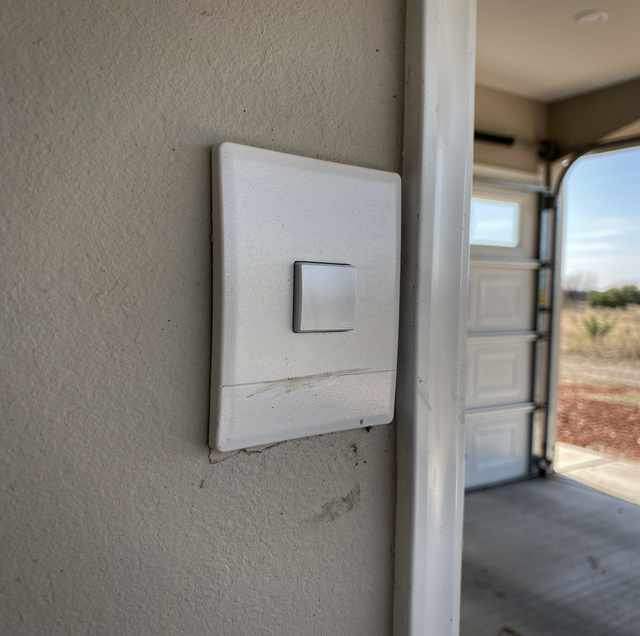
You press the wall button and the door starts down. Lift your finger, and it stops where it sits, halfway to the floor. Press and hold again, and it will run all the way down, but only as long as your finger stays on the button. A single press does nothing on the way down, no matter how many times you try it.
That refusal is the opener telling you something specific. It can no longer confirm that the closing path is clear, so it has withdrawn its permission to close on its own. Rather than run a door down while nobody is watching, it has fallen back to a mode that requires a person standing at the wall control with a finger held down.
Holding the Button Is the Mode an Opener Falls Back To
A garage door that closes only when you hold the button down is operating in constant-pressure mode. An opener built in recent decades will not run a door down under automatic control unless a safety input tells it the doorway is empty. That input comes from a pair of sensors mounted near the floor on either side of the opening, and the control board watches them the entire time the door is moving.
When the board stops receiving that confirmation, it withdraws automatic closing and keeps exactly one path open: constant pressure at the hardwired wall control. The engineering assumption behind that path is that a person with a finger on the button is standing where they can see the doorway, and that a person who sees a child, a pet, or a bumper in the way will let go. The opener requires a person to be present and pressing the button for as long as the door is closing.
This is protection doing its job. The conditions below account for most of them, and the opener answers each one the same way because it has no way to distinguish one broken input from another.
A door that will not close on its own is not a door to leave closing on a timer, a remote, or a smart-home schedule. The fallback exists so a person stands where they can see the doorway.
Sensors Knocked Out of Aim Stop Confirming the Doorway Is Clear
The two sensor units sit on brackets bolted to the vertical track or the jamb, a few inches off the concrete. One sends a narrow infrared beam straight across the opening. The other receives that beam and holds a circuit closed for as long as it keeps receiving it. Interrupt the beam and the circuit opens.
Those brackets live in the busiest part of a garage floor. A bike pedal, a trash can wheel, a mower handle, a shoulder carrying boxes: any of it can nudge a bracket. The beam is narrow, and the throw across the opening is wide, so a small shift at the bracket throws the beam well off target by the time it reaches the far side. The receiving unit sees nothing and reports nothing, and the board hears silence.
Aim is not something to bend back by hand and call finished. A bracket that moved once will move again if the mounting is loose or bent. Returning the pair to solid, repeatable aim is bracket-and-mounting work, and the circuit has to hold through a full cycle afterward before it means anything.
A Clouded or Blocked Lens Reads the Same as an Obstruction
Nothing has to move for the beam to fail. Enough film on the lens will do it on its own. Garage air carries exhaust soot, tire dust, and the fine grit that comes off the slab every time a car pulls in, and it settles on a lens sitting inches above the floor. A spider stringing a web across the face of a sensor accomplishes the same thing faster.
Condensation is the second version of that failure. In an unconditioned garage, warm, humid air against a cold sensor housing condenses moisture on the inside of the lens, where nothing can reach it. Interior fogging usually indicates a housing that is no longer sealed, which is a different repair than a dusty face.
A filmed or fogged lens is one of the most common reasons an opener drops into constant pressure, worth knowing before assuming the electronics are dead. Plain physical blockage belongs in the same category: a storage bin pushed against the jamb, a bag of soil, a coiled hose leaning where the beam crosses. The opener cannot tell a hose from a child, which is exactly the point of the circuit.
A Damaged Low-Voltage Wire Interrupts the Signal Before It Reaches the Board
Each sensor connects to the opener head through a pair of small-gauge conductors, usually stapled up the jamb and run along the ceiling. That wire is the most vulnerable part of the circuit.
A staple driven a hair too deep pierces the insulation and shorts the pair together. A conductor pinched behind a bracket can break its strands, while the jacket still looks perfect. A splice made years ago in a damp garage corrodes at the twist until it passes almost nothing. Wire that flexes where it enters the opener head work-hardens and fractures inside the jacket. Rodents chew it.
Whatever the cause, the board sees an open or shorted circuit and treats it exactly as it treats a blocked beam, since those are the same event to a board reading voltage across a pair of terminals. Wiring faults do carry a signature worth noting: they tend to be intermittent. A door that closed normally all last week and demands the button today is pointing at a connection that opens and closes with movement rather than at a dirty lens.
A Sensor That Has Failed Outright Never Reports at All
Safety sensors are electronics on a bracket a few inches off a concrete floor, in a space that swings through a wide temperature range and takes in whatever blows under the door. They get wet, they get struck by a car door or a bicycle coming in, and they take surges through the opener when lightning finds its way into the house.
A sender that has failed puts out no beam, and the receiver correctly reports an empty circuit. A receiver that has failed reports nothing even with a perfect beam landing on its lens. Either way, the board loses confirmation, and the door is under constant pressure.
Because both sensors draw their power from the opener's control board, a board fault can produce the same symptom as two dead sensors. That is why the board is the last conclusion rather than the first. The sensors, wiring, and connections at the head are ruled out before anyone decides the board is at fault.
Binding Doors and Damaged Track Make the Opener Read Resistance as an Obstruction
Some cases never involve the safety beam at all. An opener also monitors how hard it is working and how far the door has traveled, and it will stop or reverse a closing door that encounters more resistance than it expects. A door that binds hands it that resistance on every cycle.
Binding has physical causes: a track bent where a bumper caught it, a roller with a flat spot or a seized bearing, a hinge pulling out of a section, a section knocked out of square. The counterbalance matters here as well, since a door that has drifted out of balance leaves the opener pushing against weight it was never sized to carry. The board reads it all as something in the way.
The resistance is the thing to correct. A door that starts down on its own and reverses partway back up, or an auto-reverse test that needs to be run, is a separate diagnosis from a door that will not start down at all.
Turning up the closing force to push a binding door through resistance is the wrong fix. Force sensing is what stops a door on a person or a car, and forcing it past binding disables that protection.
A Technician Verifies the Whole Safety Circuit Before the Door Closes Unattended Again
Getting the door to close on a single press again is only the start of the check. The safety circuit is confirmed end-to-end before the door is trusted to close when nobody is standing at the wall.
That means both sensor units are powered and reporting, the wiring is continuous from each unit to the terminals at the opener head with no shorts between conductors, and the brackets are solid enough that the aim holds when the door runs and the track flexes. It means watching the beam hold through a full closing cycle rather than with the door parked, because a marginal alignment survives a still door and fails a moving one. It means running the door repeatedly, since an intermittent fault will pass the first cycle and fail the fourth.
The door itself gets checked on the same visit: full travel with no binding, rollers turning freely, track true, hardware tight, balance right. Then the reversal behavior gets confirmed, so both layers are back in service. Only when the door completes cycle after cycle on a single press, with the safety input reporting the whole way down, has it earned the right to close with nobody watching it.
Frequently Asked Questions
The safety beam governs the closing cycle only. Nothing on the way up can be crushed against the floor, so the opener has no reason to refuse an upward command. The moment you ask for downward travel, the board looks for confirmation that the path is clear, and that is when it stops accepting a single press.
Constant pressure has to come from the hardwired console, the button that holds a physical circuit closed at the opener head for as long as a finger stays on it. A wireless wall console, the battery-powered kind with no control cable running to the header, sends a single radio command the same way a remote does, so it cannot hold that circuit closed. If your wall unit is wireless, expect it to behave like a remote here, even though it sits on the wall.
Most openers report an interrupted safety circuit by blinking, either at the sensor units themselves or with the overhead work light on the opener head. Manufacturers publish flash-code charts that map a blink pattern to a specific fault, and those charts differ by brand and board generation. The pattern is useful information to pass along when you call, because it narrows the search before anyone climbs a ladder.
It can. Low-angle direct sunlight striking the receiving lens washes out the infrared beam the lens is trying to detect, and a west-facing opening in the late afternoon or an east-facing one at sunrise is the usual setup. The tell is a door that behaves for most of the day and refuses to open, even when it's the same window every time. Shielding and aim both affect how prone an installation is, so a daily repeat is still worth a service call.
Manufacturers specify mounting them low, generally no more than about six inches above the floor, because the design case is a small child or a pet crawling under a closing door. A beam at waist height would miss precisely what matters most, and that low mounting is also why the sensors take so much abuse from stored items, water running across the slab, and vehicles pulling in.
Sensors are sold as a matched pair, specific to the opener brand and often to the board generation inside it, so a set that looks identical can fail to satisfy a different manufacturer's circuit. Swapping the units is also the easy half of the job. Mounting height, solid brackets, repeatable aim, and a circuit verified over a full cycle are what restore the door to automatic closing.
A door that only closes when you hold the wall button is reporting a safety fault that must be found before it closes on its own again — a free on-site diagnosis identifies which sensor, wire, or door issue is causing the fallback, with a written quote before any work starts. Arnold's Garage Door & Gates serves Fort Worth, Alvarado, and the DFW metroplex. Call Arnold: 682-337-7220.
