
Garage Door Keypad Stopped Working in the Heat? What Fails First
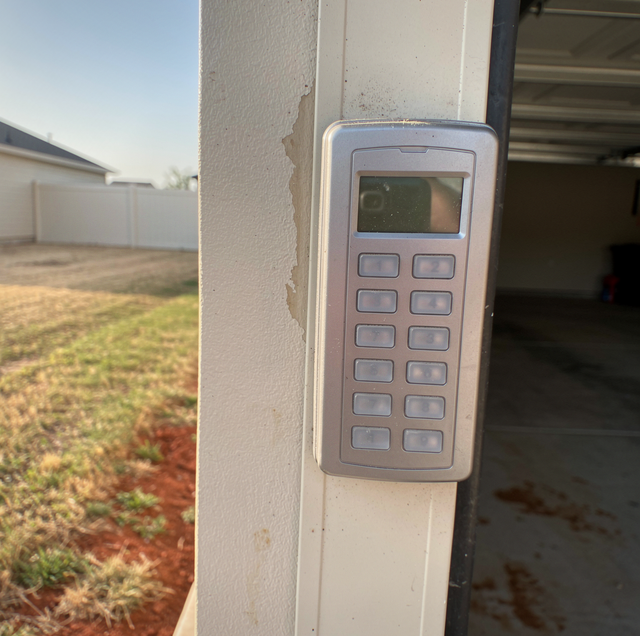
You punch in the same four digits you have used for years. The keys light up under your finger, the pad chirps, and the door stays exactly where it is. Earlier in the day it worked. By late afternoon it does not, or it quit somewhere in between and has not come back since.
Of the four things stacked inside that box on the jamb, the battery has the lowest temperature ceiling, so it is the layer to suspect first. The way heat takes it down is quieter than the symptom suggests, and the three layers around it fail in ways that look nearly identical from the driveway. What makes them worth separating is where the device lives: a handheld transmitter rides in a cupholder, while the pad on the jamb takes sun, rain, and the daily temperature swing of an exterior wall every day it exists.
The Key Surface Fails Where Your PIN Lives
The face you press is a molded silicone mat with a separate key for each digit. Silicone gets used for this partly because it tolerates heat and sunlight better than most elastomers, which is why the mat outlasts nearly everything around it. What ages first is the printed or coated legend on each keytop, the clear lens over the display window, and the gasket that seals the mounting plate to the jamb. Sun chalks and embrittles those housing plastics while the mat underneath stays flexible.
That wear lands unevenly, and the pattern belongs to your household. Only four of the keys on that pad ever get pressed, so the rest are close to new after a decade. The surface layer announces itself as a small group of keys going soft and vague while the others still feel crisp, and the soft ones are your code. Pull an old pad off a jamb and you can sometimes read the number straight off the keytops, by which four have lost their printing.
The gasket matters more than it looks like it should. Once it hardens and stops sealing, dust and humid air reach the inside of the pad, and the consequence shows up one layer down.
Contact Happens Only at the End of the Key's Travel
Under each key is a rubber dome, and molded into the underside of that dome is a conductive pill: carbon particles mixed into silicone. The board below carries two interlaced conductors under each key, and pressing the key collapses the dome until the pill lands across both, bridging them. The switch closes at the end of the key's travel, and nowhere before it, so anything that shortens travel or puts a film between the pill and the board keeps the key from registering even though your finger felt it move.
Resistance across that contact is not zero and does not stay put. A new conductive-rubber switch measures under 50 ohms; the carbon pill itself generally in the 20 to 100 ohm range when fresh. That resistance increases with use as contamination degrades the pill surface, and dust and moisture that enter past the hardened gasket settle on the exposed board conductors. The same press that closed the circuit last year now targets a dirtier one.
A key that works when you press it hard and dead center but does nothing under a normal press is a contact problem. So is a single digit that has stopped answering while the pad still lights and still beeps for the others. The fault stays confined to the keys you press, which is the tell that separates it from anything electrical further in.
Why a Sun-Baked Battery Still Reads Fine on a Meter
Heat runs opposite to what the afternoon symptom implies. An alkaline cell discharges more efficiently when it is warm because the ions that carry the reaction move more freely and its internal resistance falls as temperature rises. Heat does not remove volts from the cell today. It takes months off the cell's life.
The reactions that produce current continue to run when nothing is drawing current from the cell, and heat speeds them up. A cylindrical alkaline cell loses roughly 3 percent of its capacity per year at ordinary room temperature, and that self-discharge rate increases with the temperature at which it is held. There is a second, slower kind of damage as well: cycling between hot days and cool nights expands and contracts the cell's components until seal integrity fails, which is where leaks start.
An alkaline cell that has leaked is wet with potassium hydroxide, a caustic. Do not wipe a crusted battery compartment out with a bare hand. Wear gloves, and keep the residue well away from your eyes.
None of it shows on a multimeter, which is where people get sent down the wrong road. A meter reads the open-circuit voltage, taken with essentially nothing flowing, and that number holds up long after the cell can no longer deliver. What moves underneath is internal resistance, which starts at roughly 150 to 300 milliohms in a fresh cell and climbs as reaction byproducts coat the electrode surfaces. Voltage drop under load is the product of the load resistance and the current drawn, so a tired cell can post a healthy resting number and sag the instant something draws real current.
This is also why the failure can arrive out of season. A cell that spent a hot stretch on a sun-facing wall may run fine until the first cold morning of the year, because cold slows the same chemistry and drives internal resistance back up. The heat spent the reserve. The cold makes the remainder visible.
The Radio Burst and the Pairing It Carries
A wireless keypad is a transmitter with a gate in front of it. The digits you enter are compared with a number stored in the keypad's memory, and nothing leaves the pad until the two match. What it sends then is a short radio burst carrying the keypad's identity. The number you punched in stays inside the pad.
That burst is the heaviest thing the cell is ever asked to do. Between presses, the pad draws almost nothing. Then, for a fraction of a second, the transmitter section draws current far above that resting draw, and a cell with high internal resistance can light the backlight, accept all four digits, and still collapse to a voltage the radio needs. From the driveway, that looks exactly like the door ignoring you.
The other thing a dead cell can take with it is the pad's side of the pairing. Instructions for replacing the battery in a wireless keypad often include a reprogramming step, which is why a fresh cell on its own can leave the pad as inert as the flat one. Whether that means re-entering the number at the pad or re-teaching the pad at the opener depends on the model, and the sheet that shipped with the unit is the only reliable guide. The receiver in the ceiling still holds its list. What went missing is on the jamb.
Mounting Position Is the One Variable You Control
Nothing described so far can be redesigned by a homeowner. Where the pad sits can be. A keypad on a jamb that catches direct afternoon sun spends hours a day well above the air temperature around it, because a small dark plastic box in full sun absorbs solar gain and holds it. The identical pad on the shaded side of the same building lives close to whatever the air is doing.
Battery makers specify an alkaline operating range of 0 to 131 degrees Fahrenheit and advise against placing battery-powered devices in hot environments. A keypad on a sun-facing jamb spends clear afternoons pressed against the top of that range.
The difference reaches every layer at once. Sun-side housing plastics chalk sooner, the gasket hardens sooner, the cell self-discharges faster, and the day-to-night swing that works the battery seal is wider on a surface that heats in the sun and then dumps that heat after dark. A shaded pad reaches the same place. It just takes years longer to get there.
Reading the Symptom Back to Its Layer
Start with the cell, because it is the only one of the four layers you can restore. A worn contact and a hardened gasket are one-way. A cell is a two-minute swap that either changes the symptom or eliminates itself from the list.
Eliminate it properly, though. A fresh cell that does not bring the pad back has not cleared the battery, because the reprogramming step may still be owed. Run the manufacturer's sequence for that model before you decide the cell was innocent. It is an easy place to talk yourself into buying a keypad that was working.
From there, the signatures separate cleanly. A pad that stays completely dark, no backlight and no chirp, is a power-path problem, meaning the cell or the contacts holding it. A pad that lights but answers some keys and not others sits at the contact layer. A pad that lights, takes all four digits, and gives its confirmation while the door does nothing has passed everything on the jamb, which puts the fault at the burst or the pairing. And if the wall button inside the garage is dead too, the trouble sits in the opener rather than anywhere on the jamb.
One caution about a pad that has spent years on a sun-facing wall: every layer in it aged on the same schedule, so a fresh cell can bring it back for a few weeks and then hand you the driveway again when the worn contact takes its turn.
Frequently Asked Questions
Test the cell under load rather than at rest. Put it across roughly a 10-ohm load for one to two seconds and read the closed-circuit voltage: a fresh 1.5-volt alkaline reads about 1.5 volts that way, and one reading 1.1 volts has around 20 percent of its service left. A cheap battery tester applies that calibrated load for you.
A confirmation flash or tone after the last digit means the comparison inside the pad passed, so the keys and the code are fine. From inside the garage, standing clear of the door's path, watch the indicator on the opener's powerhead while someone enters the code outside. If it flickers, the burst arrived, and the door has a separate problem. If it never reacts, nothing usable is leaving the pad.
Take the cell out first. A flat cell left in a hot compartment is the one you find corroded to the contacts months later, and that residue eats the battery terminals and the traces on the board, turning a battery problem into a replacement. Battery makers recommend inspecting any battery compartment every few months for that reason.
Where the unit takes AA or AAA cells and the manufacturer allows it, lithium primaries hold up better: they retain more than 90 percent of their charge after 15 years of storage, compared with roughly 80 percent at 10 years for alkaline, and they work across a wider temperature range. Use the size and type specified by the unit. Plenty of keypads take a 9-volt or a coin cell, but that swap isn't on offer.
Range is not the constraint over a distance that short, so relocating a few feet costs nothing electrically. Two other things do matter: the new position still has to be reachable from a car window without getting out, and the old screw holes need to be sealed because two open holes in the wood trim wick water straight into the jamb.
The receiver runs on house current, so no cell is sitting there losing capacity, and its board is inside the building rather than on the weather side of it. What it does get is the warmest air in the garage, which collects at the ceiling where the powerhead hangs. Heat trouble at that end shows up in the motor and the logic board, on a different symptom list.
Have the keypad tested along with the opener it talks to — a technician can check the pad, the cell, and the receiver's response in one visit instead of guessing at parts to replace. Arnold's Garage Door & Gates serves Fort Worth, Alvarado, and the DFW metroplex. Call Arnold: 682-337-7220.
