
Garage Door Frozen to the Concrete: What Actually Breaks
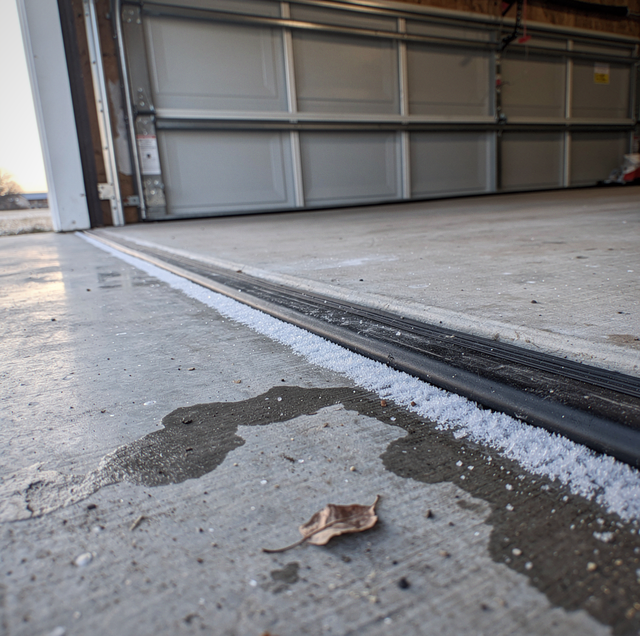
The first hard freeze arrives a few hours before dawn. By seven the calls start, and most describe the same morning: the button got pressed, the opener groaned, and the door did not move an inch.
Nothing was wrong with that door the evening before. What changed overnight is that a thin film of water between the bottom seal and the concrete turned solid, and the door is now stuck to the slab across its full width. Everything that goes wrong next comes from what the machinery does when it pulls against a bond nobody can see.
How a Bottom Seal Bonds to a Slab
The bottom of a sectional door carries a rubber or thermoplastic bulb held in an aluminum retainer running the full width of the panel. Its job is to squash flat against concrete that is never perfectly level, filling the low spots so the opening closes off. With the door down, that bulb is in continuous contact with the slab for 16 feet or more.
Water reaches that contact line from several directions. Rain blows under the door and wicks along the seal. Sleet or snowmelt drains back toward the opening across a slab settled toward the house. A wet vehicle parked inside drips and runs forward. Grit packed inside the retainer holds a wet line against the concrete long after the driveway looks dry.
When the temperature falls through freezing, that film turns to ice, and ice in a thin layer between two surfaces is a strong adhesive. Weight has nothing to do with it. The ice grips the rubber to the concrete in shear along the entire contact strip, and the force required to break that bond scales with the extent of the wet strip. A puddle at one corner gives way easily. A continuous wet line across the full opening does not.
The Opener Pulls, the Spring Unwinds, Nothing Moves
Press the wall button and the counterbalance system does exactly what it always does. The torsion spring above the opening is wound tight with the door closed, and it starts unwinding the instant the shaft turns, feeding torque through the cable drums into the lift cables on both sides. The opener adds its own pull at the top section. The opener is not what lifts the door; it supplies the small extra push that covers friction and whatever imbalance is left over.
On a normal morning all of that becomes motion. On this one, none of it does, and the energy has nowhere to go except into the parts between the motor and the frozen seal.
The lift cables draw tight and stay tight while the drums keep trying to wind them. The bottom brackets, where those cables anchor to the lowest section, take the full pull at the exact two corners stuck to the floor. The top section absorbs the opener arm's push, while the rest of the door refuses to follow, which is how the top section gets bent around its own strut and how the opener bracket starts tearing out of the steel. The drive gear inside the opener head keeps turning against a load it was never sized to move.
Every part of the drive train is carrying far more than a normal lift produces, and the door has not moved at all. That is the whole event, and it takes nothing more than a wet slab and a cold night.
Why the First Cycle of the Morning Is the One That Breaks Things
The timing is not a coincidence. Outdoor air reaches its minimum shortly before sunrise, and an unheated garage follows within an hour or so. That is also when most doors make their first movement in eight or ten hours.
The water has had all night to freeze. A film that formed at eleven and dropped below freezing at four is fully solid and fully bonded by six, while the same film hit by an afternoon cold snap would still be forming when the door next ran.
The door has also been closed the entire time, in the position that holds the spring at its highest wind and stress, since a closed door holds the whole weight in reserve. That most loaded state sits in the coldest steel the spring will see all year, for hours, with nobody watching.
The steel is at its least forgiving, too. Cold spring steel deforms less readily at the tip of a crack, so a coil already carrying fatigue damage has less margin at six in the morning than at noon. Age is the wrong unit for a spring, which is rated in cycles rather than years, and cold did not break the one that let go last night. It finished a break already most of the way there.
The frozen seal is what turns that narrow margin into an event. A spring near the end of its life might have carried an ordinary lift without complaint. It does not get an ordinary lift. It gets a lift into a bond, at the coldest hour, on the door's first movement of the day.
What Else Changes Between the Seal and the Rollers
The seal goes stiff before the water even freezes. A cold bulb stops shaping itself to the concrete, stops filling the low spots it filled in September, and leaves a strip of daylight at the moment it should be sealing water out.
Grease is the smaller effect. Lubricant in the roller bearings, hinge pins, and the opener rail thickens as the temperature drops, so the first cycle of a cold morning is slower than the second. That costs the door a little speed and nothing else. Neither approaches what a bonded seal does: stiff grease adds drag, while a frozen seal refuses to let the travel begin.
What Repeated Presses Actually Cost
The natural reaction to a door that will not move is to press the button again, and that is where a cold morning turns from an annoyance into a repair or an injury.
Each press repeats the overload from the top: full torque into a bond, full tension on the cables, full push on the top section, full strain on the drive gear. Nothing about the second attempt is gentler than the first, and every part closest to its limit is closer after it.
The injury exposure sits alongside the equipment damage, and it is the half that gets underestimated. A bond that finally lets go under load does not release gradually. The door breaks free all at once with the system already at full tension and moves fast through the first several inches. A cable drawn tight over and over can part while it is loaded, dropping one side of the door and sending a cable end whipping across the opening. A top section that tears away from its opener bracket releases a panel edge onto whatever is beneath it.
Do not pull the emergency release cord while the door is up or partway open. With the counterbalance gone, the trolley is the only thing holding the door, and releasing it drops the full weight.
A door dragged partway up on a stuck seal is not holding itself up. The trolley and the opener are holding it, against a counterbalance no longer doing its share. Nobody stands under it, nobody reaches under it to chip at ice, and nobody leaves a child or a pet in the opening while it waits.
What to Do Instead on a Frozen Morning
Look at the bottom edge before the opener. Ice along the seal line means a stuck door. A gap of an inch or two in the coil above the opening, or a door that rises a few inches and stops, means a broken spring instead.
Clear what is on the outside first. Ice along the apron and the seal line can be broken up and swept back with a plastic tool that will not gouge the rubber or chip the concrete, and warm water poured along the line works as long as it drains away from the door rather than pooling to refreeze. Rock salt against an aluminum retainer and a concrete slab is a poor trade.
Give the seal one deliberate attempt rather than five, with your eyes on the bottom edge instead of the opener head. If the door lifts free, let it run a full cycle, then look at the seal where it separated, since a bulb can tear along its length.
If it does not move, stop. A door that will not break free is reporting something specific, and the opener is the wrong instrument to answer with.
Keeping the Seal Line Dry Before the Next Freeze
The bond needs water at the seal line, a temperature below freezing, and time. Only the first is under anyone's control.
Most of that work is getting water away from where the door lands. The retainer along the bottom edge collects grit, leaves, and sand, and packed debris holds moisture against the slab for days after the surface looks dry. Clearing it out takes a broom and a putty knife. Where a slab has settled, and the driveway runs back toward the opening, the water line has to be moved outside the door rather than managed under it.
A related point concerns replacement day rather than a frozen morning. On a two-spring door, both springs get replaced together, because they went onto the same shaft on the same day and have counted the same cycles ever since. Higher cycle ratings get chosen at that same moment, since they come from the spring's geometry and cannot be added to one already on the shaft.
A wound torsion spring holds enough energy to break bones, and a spring that has already snapped can still hold plenty. Nobody should wind, unwind, adjust, or replace one. That work belongs to a technician.
Frequently Asked Questions
Warm air aimed along the seal line does work, slowly, and it is safer than force. The risk is what the heat lands on. Rubber and thermoplastic seals distort under direct heat, and an open flame near a seal, a retainer, or the fuel containers most garages keep somewhere is not worth the minutes it saves. Warm water and a plastic scraper do the same job with fewer ways to go wrong.
It does, and it twists the door in a way a full-width bond does not. When one corner is stuck, and the other is free, one side lifts while the other stays down, so the door is briefly raised at one end only. That is how a bottom section gets racked out of square, how a roller leaves its track, and how one lift cable ends up slack on its drum.
Often, and that is the better outcome. An opener learns roughly how much force a normal cycle takes and stops when it meets far more, so a correctly set force limit is usually what saves the door. A unit whose limits were turned up over the years to cure some earlier complaint has given that protection away, so a door that never trips its limit is not automatically in good condition.
The surviving spring keeps delivering exactly the torque it was wound for. It does not take up the broken one's share, it is not pushed outside its intended stress range, and it does not burn through its remaining cycles faster than it did the week before. What changed is the door, now short roughly half the counterbalance it needs, and that missing lift routes into the opener and its drive gear, the lift cables, and the top section. Those are the parts damaged by running a door in that state.
A heated garage does. An insulated door alone helps less than people expect, because the slab is the other half of the bond, and concrete changes temperature far more slowly than air does. A garage sitting just above freezing at the door line can still hold a slab cold enough to freeze the film under the seal.
No. A door left partway up hangs on the trolley and the opener rather than on a balanced counterbalance; it leaves the garage open to the weather, causing the problem, and it puts an unsupported panel edge at head height in the dark. If the concern is the seal freezing down, the answer is a dry slab under a closed door.
Have the door checked after a morning it would not break free — the cables, drums, bottom brackets, top section, and opener force settings all carried that overload and are worth inspecting before the next freeze. Arnold's Garage Door & Gates serves Fort Worth, Alvarado, and the DFW metroplex. Call Arnold: 682-337-7220.
