
Garage Door Opener Vibration — Why It Shakes the Ceiling Above
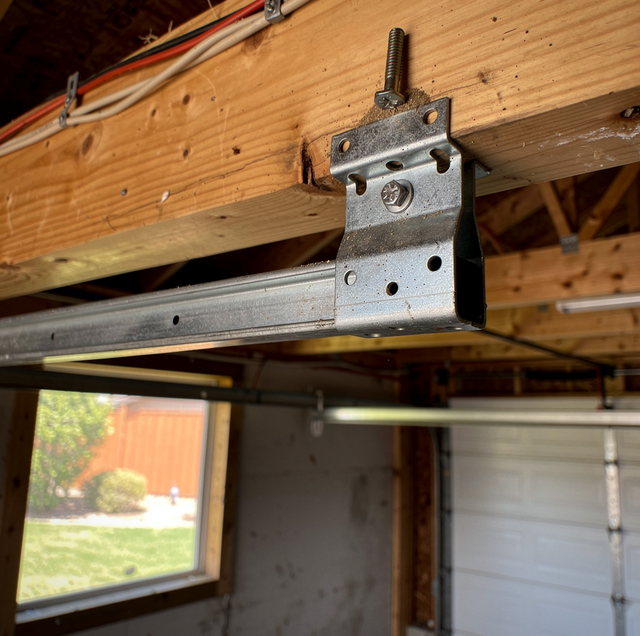
The picture frame on the wall above the headboard ticks against the drywall, a small syncopated rattle that starts a beat after you hear the door open downstairs. You're not in the garage. You're not even in the room above it — the vibration has traveled through a hallway wall, across a run of ceiling joists, and up into a bedroom that shares no wall or floor with where the opener hangs. Whatever announces itself down there gets picked up and carried by the house itself, and by the time it reaches you, it has nothing left in it that sounds like a motor.
What reaches your bedroom or your home office rarely sounds like the motor at all. It's a lower, duller presence: a hum in the walls, a rattle that starts and stops with the door cycle, a picture frame or a closet door that answers to a rhythm nothing in the room is making. Tracing that rhythm back to its source means following the path it took, not just listening at the ceiling directly overhead.
Which drive type runs quietest in the garage itself is a separate question with its own answer. The one this piece follows is what happens to the noise after it leaves the opener and enters the framing, no matter which drive produced it in the first place.
What Starts Moving Inside the Opener
Every opener produces some vibration simply by running: a motor spins, a drive mechanism advances, a trolley pulls an arm connected to the door. In a healthy unit, that motion remains smooth and low-amplitude, and it dies out at the housing. The rattle that reaches your bedroom almost always starts with a part that has moved past normal wear and is now generating motion the design never intended.
A roller that has worn oval instead of round is a common starting point. As it turns, it doesn't press evenly against the rail or track; instead, it pushes a small pulse into the housing on every rotation. A sprocket that has loosened on its shaft behaves the same way: instead of turning true, it wobbles with each pass, and that wobble becomes a mechanical knock transmitted into the rail.
Chain slack contributes a different kind of noise. As a chain lengthens or a sprocket wears, it can develop enough play to slap against the rail at the reversal points of each cycle, the moment the door starts and stops. That slap is louder, sharper, and more irregular than the steady hum of a motor running cleanly, and it couples into the mounting hardware with greater force per event, even though it happens less often.
Motor mounts play a quieter but steadier role. The rubber or composite isolators a motor sits on are supposed to absorb the small vibration a motor produces. Once those mounts age and stiffen, they stop doing that job, and vibration that used to die out inside the housing instead passes through into the rail and the bracket holding it.
How That Motion Gets Into the Ceiling
None of that motion would matter upstairs if it stayed inside the opener housing. It reaches the house because the opener and its rail are bolted directly to the structure that holds your ceiling up, with no material in between that's soft enough to interrupt it.
The rail typically hangs from a run of punched-metal hanger straps, each one lag-bolted into a joist. That's a rigid, all-metal connection end to end: strap to lag bolt, lag bolt to joist, joist to the rest of the framing. Metal transmits vibration efficiently because it doesn't flex or absorb energy the way a softer material would. A rigid connection carries a pulse from one end to the other with very little of it lost along the way, which is exactly what a hanger strap and lag bolt do by design: hold weight rigidly, and that same rigid connection carries vibration straight through.
The header bracket at the wall, where the rail's other end anchors above the door opening, does the same job in reverse. It ties the rail rigidly into the wall framing at that end, so vibration generated near the motor has two hard paths out instead of one: back through the hangers into the ceiling joists, and forward through the header bracket into the wall framing beside the door.
The rail and motor hang from framing above head height, held by hardware sized for that load. If a strap or bracket looks bent, cracked, or pulled loose, that's a technician's repair, not something to tighten yourself.
Why Framing Carries the Sound So Well
Wood-framed construction is good at carrying exactly the kind of vibration an opener produces. Motors, chains, and drive gears generate energy mostly in the low-frequency range, and low frequencies travel through continuous framing members with very little loss. A joist that runs from the garage ceiling into an adjoining room's floor doesn't know where one space ends and another begins; it's one continuous piece of wood carrying whatever motion gets fed into it at either end.
That continuity is also why the vibration doesn't confine itself to the space directly above the opener. Joists, wall studs, and subfloor sheathing form a single connected structural system spanning many rooms, not separate segments that stop at walls. Vibration fed in at one point can travel along several connected paths before it reaches a ceiling in the room above.
Why the Room Above Isn't Always the Loudest
The room directly over a garage is often finished differently than the rest of the house. It's frequently a bonus room added after the original construction, sitting over a ceiling that was never given the heavier drywall buildup, added insulation, or resilient channel that would interrupt the direct path between the framing and the living space in a more finished part of the house.
That kind of ceiling does almost nothing to absorb what arrives from below. A room finished to a different standard, elsewhere in the house, can end up quieter than the bonus room directly overhead even though it sits farther from the opener along the framing. Distance from the source matters less than how much stands between the vibrating structure and the room a person is actually sitting or sleeping in.
What Arrives in the Room Upstairs
By the time vibration has traveled through hangers, joists, and a thin ceiling assembly, almost nothing about it still sounds like a motor or a chain. What you actually notice upstairs is usually a low hum that rises and falls with the door's travel, a rattle in a picture frame or a loose window pane, or a buzz in something mounted to the same framing that resonates at a frequency close to what the opener is feeding into the structure.
This is also where drive-type stops matter less than people expect. A chain drive, a belt drive, and a screw drive generate different sounds at the source, but once a unit is bolted rigidly into worn framing hardware, the structure carries whichever one it's fed with about the same efficiency. A quieter drive mechanism at the opener doesn't guarantee a quieter ceiling upstairs if the mounting hasn't changed.
Treating the Vibration Instead of the Symptom
Addressing a shaking ceiling starts with the source, not the room where it's heard. A technician checks the moving parts first: the roller, the sprocket, the chain, and the motor mounts, because a worn part generating unnecessary motion is easier and more effective to correct than trying to isolate that motion after the fact. Replacing what's actually worn often reduces the noise more than any change made at the ceiling.
Where the mounting itself is the primary contributor, vibration isolation becomes a legitimate second step rather than a substitute for the first. A technician can install isolators between the hanger strap and the joist to absorb motion at that connection point instead of passing it straight through. Solid blocking added between joists near the mounting points can also stiffen the framing, helping it resist flexing at the frequency the opener produces. Both are structural decisions made after the source has been addressed, not instead of addressing it.
Have someone run the opener while you stand in two different rooms and note where the sound changes most. That comparison tells a technician more about the transmission path than volume alone.
Why Quieting the Room Is a Different Job From Quieting the Opener
Fixing a worn roller or a hardened motor mount changes the opener's output. It doesn't change how the framing responds to any leftover noise, and it doesn't change how a bonus room's thin ceiling or a bedroom's loose window pane reacts to vibration that's already reduced but not eliminated. Those are two separate problems with two separate sets of tools.
A technician working the opener side is chasing amplitude at the source: less motion made, less motion to carry. A technician working the room side, when that's warranted, is chasing transmission and response: how much of what's left gets through the structure, and what in the room amplifies or dampens it once it arrives. If your ceiling still shakes a little after the opener has been fully serviced, that usually means the two jobs were never the same job to begin with.
Frequently Asked Questions
A door on the larger end of common residential sizes needs a longer rail, and a longer rail hangs from more hanger straps along its run than a standard door's rail requires. Each additional strap is another rigid connection to the ceiling joists, giving a bigger door opener more attachment points that feed vibration into the framing than a standard door opener has.
It can. The vertical track brackets that anchor the door's track to the framing beside the opening are a separate mounting point from the opener's own hangers, bolted into wall studs rather than ceiling joists. A bracket that has loosened there can generate and transmit vibration into an adjoining wall even when the opener itself is fine.
Some DC-motor models include a battery backup pack mounted on the opener housing or on a nearby shelf as part of the model's equipment. If that pack isn't seated firmly, it can buzz or shift against its mount independent of the drive mechanism, adding a rattle of its own. A technician checks that the battery pack is mounted separately from the rail and motor hardware, since a loose battery pack points to a different problem than a worn roller or sprocket.
Yes, and it's often mistaken for a wiring or fixture problem rather than a vibration one. A ceiling fan, a pendant light, or a recessed can mounted near the affected framing can pick up the same motion and buzz or rattle on its own mounting hardware. Tightening the fixture rarely helps for long if the vibration feeding it hasn't been addressed at the source.
It can shift rather than simply worsen. Wood framing expands and contracts with humidity and temperature, which changes how tightly framing members sit together at any given time, and a looser seasonal fit can carry vibration differently than a tight one. A rattle that seems to appear or disappear with the weather is often the same vibration source behaving differently in framing that's temporarily looser or tighter.
The source can generate a similar amount of motion either way; what changes is the path. A jackshaft-style opener mounts to the wall beside the door instead of hanging from the ceiling, which couples its vibration into wall studs and the header area rather than into the ceiling joists a bedroom floor sits on. That difference in path can change which room notices it most, even when the opener itself is generating similar motion.
Trace the vibration back to its source before you assume the opener needs replacing — a diagnosis that separates a worn part from a mounting problem saves you from fixing the wrong one. Arnold's Garage Door & Gates serves Fort Worth, Alvarado, and the DFW metroplex. Call Arnold: 682-337-7220.
